When the Storm Feels Like the End

Mark 4:35–40
What’s the worst weather you’ve ever been in?
Think about it for a moment.
Did you feel calm, scared, or somewhere in between?
Do storms feel exciting to you, or terrifying?
Have you ever been caught in one while on a boat?
That last question matters more than it sounds.
The Storm They Didn’t See Coming
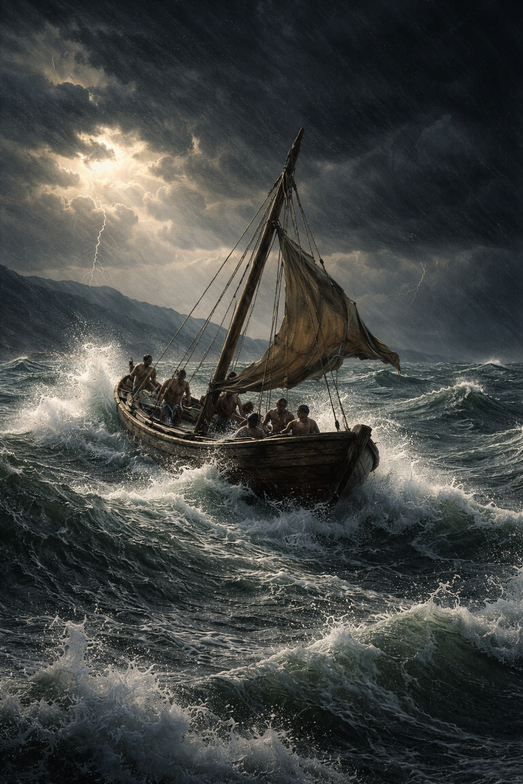
Mark tells us that “on that day, when evening had come,” Jesus said to His disciples, “Let’s cross over to the other side of the sea.” They got into the boat, left the crowd behind, and set out. Other boats followed.
Then the storm hit.
Not a mild squall. Mark calls it a great windstorm. Waves crashed into the boat until it was already filling with water. And Jesus? He was asleep in the stern, on a cushion.
So they woke Him up and said, “Teacher! Don’t you care that we’re going to die?”
Jesus stood up, rebuked the wind, and said to the sea, “Silence! Be still!” The storm stopped immediately. There was a great calm.
And then Jesus turned to them and said, “Why are you afraid? Do you still have no faith?”
A Normal Reaction
If I’m honest, the disciples’ reaction does not seem out of the ordinary to me at all.
If I were in a boat during a violent storm and thought I was about to die, I would be terrified too. That feels like a very normal human response. The disciples had seen Jesus heal people. They had never seen Him control the weather.
So if their fear makes sense, why does Jesus still challenge them about their faith?
That question is worth sitting with.
What Do We Mean by “Faith”?
We use the word faith all the time, but we do not always mean the same thing.
When someone says, “Just have faith,” what do they usually mean? Optimism? Positive thinking? Hope without evidence?
Hebrews gives us a much sturdier definition. Faith is described as assurance. Conviction. Treating unseen realities as fact. Not wishful thinking, but confidence rooted in who God is and what He has promised.
That kind of faith is very different from the way we often use the word casually.
Jesus’ Sharp Response
After what the disciples believed was a brush with death, Jesus does not comfort them. He scolds them.
Why?
It is tempting to think Jesus is being harsh, but the context matters. This was not a random storm. Look back at verse 35. Whose idea was it to get in the boat?
It was Jesus.
He suggested the trip, told them they were going to the other side, and then went to sleep.
Mark also tells us this happened in the evening, after Jesus had been teaching all day. His exhaustion makes sense. Falling asleep in the boat is a very human detail. And I can see how it would be difficult for the disciples to fully grasp that Jesus is Lord over all creation when, in that moment, He also looks like a tired man who needs sleep.
But if Jesus said they were going to the other side, what does that tell us about whether they were actually going to perish?
A Familiar Fear
The disciples believed death was imminent, and fear took over. David writes about that same kind of fear in Psalm 23 when he talks about walking through “the valley of the shadow of death.”
Notice that phrase. Shadow of death. Not death itself.
Fear has a way of making shadows feel solid.
What Faith Might Have Looked Like
There was nothing wrong with waking Jesus up. When our lives feel threatened, we should turn to Him.
But their words matter. They did not just ask for help. They declared the outcome. “We are perishing.”
Faith might still have woken Him, but it would not have assumed the ending. Faith would have trusted that He would take care of the situation, even if the storm was still raging.
The Storm Is Not the End
One last thing to notice: this storm is not the end of the story.
Jesus is taking them somewhere on purpose. On the other side of the sea, He is about to confront something even more frightening than wind and waves.
The storm felt like the main event, but it was only the passage.
And that is often how it is for us, too.

-
Our Saviour's Evangelical Lutheran Church